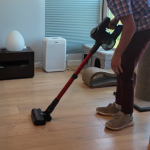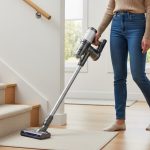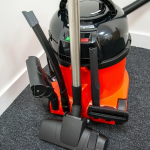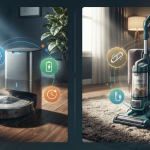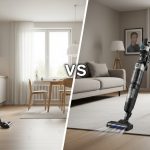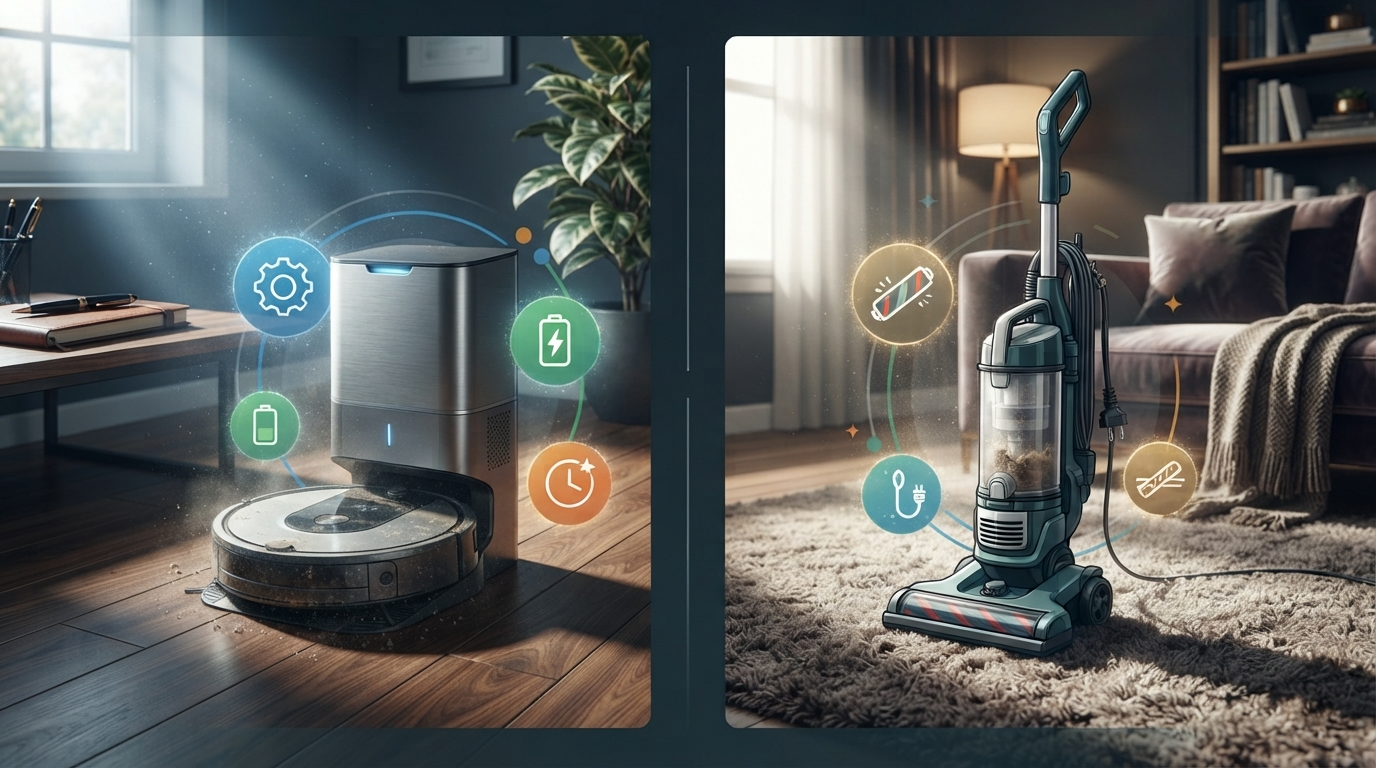
Why push a vacuum around your home when a robot can do it for you? The robot vacuum vs. upright vacuum debate comes down to one simple question: do you want convenience or control? A robot quietly handles everyday messes, while an upright lets you attack dirt, dust, and pet hair exactly where they hide.
But before you let a smart vacuum take over your floors, think about your home. The size of your space, the type of flooring you have, and how much daily mess you deal with will all shape the best choice for you. Let’s look at what actually sets these two vacuums apart and where each one has the edge.
What is the Real Difference Between a Robot Vacuum and an Upright Vacuum?
Although they operate very differently, an upright vacuum and a robot vacuum can both keep your floors clean. Robotics is the base of a robot vacuum. Without your presence, it can look over your floors, stick to a cleaning plan, and continue collecting regular dirt and particles. The foundation of an upright vacuum is manual control.
| Robot Vacuum | Upright Vacuum |
| Works automatically | Requires manual operation |
| Uses sensors and mapping to navigate | You control its movement. |
| Can follow a cleaning schedule | Used whenever you choose |
| Requires very little effort | Requires active effort |
| Follows programmed cleaning routes | You choose where to clean. |
| Uses sensors, software, and automation | Relies mainly on manual operation |
| Saves time and reduces daily effort | Gives you greater control |
| Less flexible in some situations | More flexible for different cleaning tasks |
| The main benefit is convenience. | The main benefit is control. |
Robot Vacuum Pros and Cons
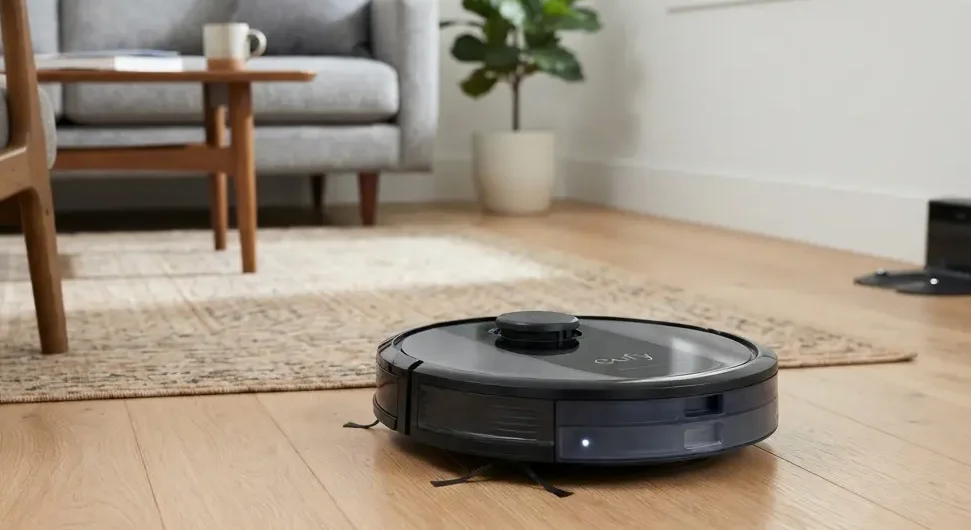
The main job of a robot vacuum is to remove daily floor cleaning from your to-do list. It is most helpful when dust, crumbs, or pet hair appear more quickly than you can clean them because you can program it to run while you work, chill, or sleep.
Pros
- Cleans while you are working, sleeping, or away from home.
- Keeps daily dust and crumbs from piling up.
- Reduces the “I need to vacuum again” problem in busy homes.
- Useful for pet owners dealing with constant loose hair.
- Makes regular cleaning easier for people who keep putting it off.
- It can reach under beds and some low furniture without you moving them.
Cons
- You still have to clear cables, toys, clothes, and other obstacles.
- Clutter can stop it in its tracks, and navigation issues can sometimes cause a robot to keep cleaning the same area.
- Small and crowded environments can limit its functionality.
- It cannot replace cleaning stairs, sofas, curtains, or other above-floor areas.
- You still need to empty, clean, and maintain it.
- It can become another device you have to manage rather than a completely hands-off solution.
Upright Vacuum Pros and Cons
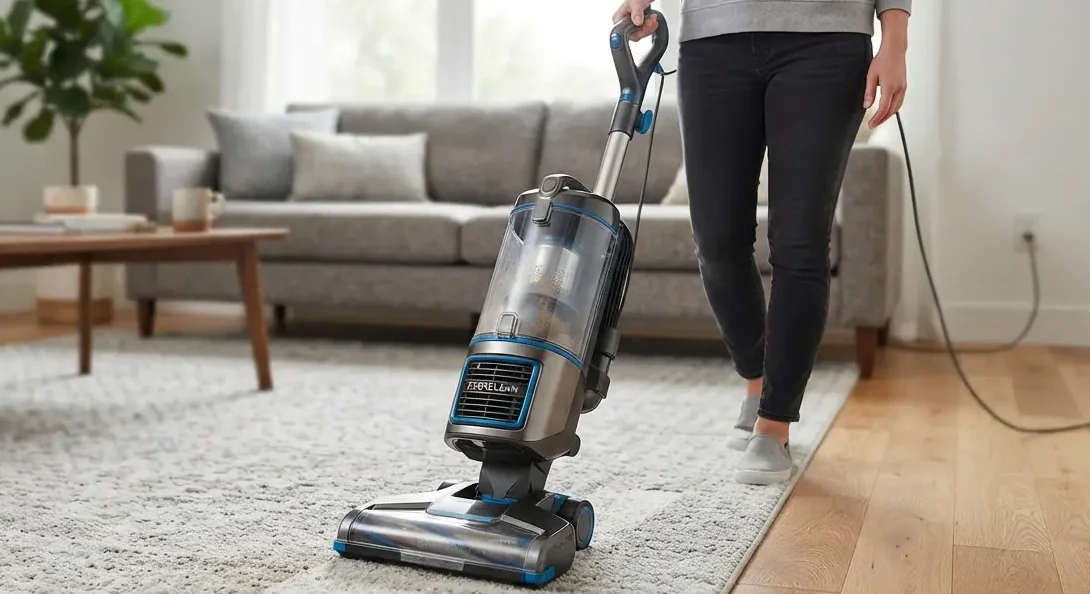
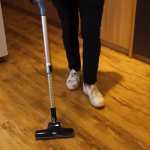
An upright vacuum gives you something a robot cannot: direct control. You decide exactly where to clean, how long to spend on a dirty area, and which attachment to use. That makes it useful when everyday maintenance is not enough and you need to deal with a specific mess.
Pros
- Lets you immediately attack a spill, pile of crumbs, or visibly dirty area.
- Better when you need to repeatedly pass over one stubborn spot.
- Useful for stairs, furniture, corners, and other areas outside the robot’s reach.
- Gives you control over exactly where you clean.
- No need to prepare the floor for navigation before starting.
- Works well as the “backup vacuum” when a robot cannot handle a particular job.
Cons
- You have to physically do the cleaning.
- Quick messes can feel like a chore because you have to get the vacuum out.
- Carrying it between floors can be inconvenient.
- Corded models can limit movement.
- Storage can be awkward in smaller homes.
- Deep cleaning still takes time even when the vacuum itself is powerful.
Which Vacuum Cleans Better?
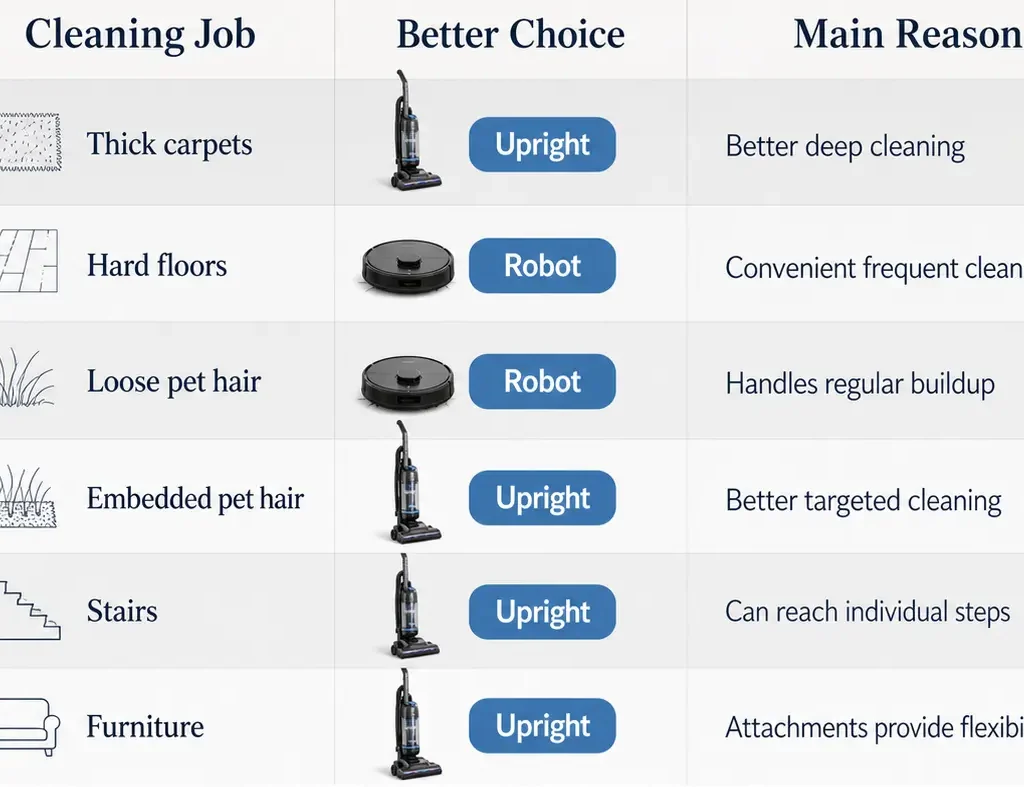
Not every cleaning task is won by either vacuum. What you are cleaning and how much control you require will determine which option is best. An upright vacuum typically has the advantage when a surface requires a more thorough cleaning, but a robot vacuum benefits at routine maintenance.
- For carpets
Upright wins for deeper carpet cleaning.
Carpet traps dust, crumbs, and pet hair inside its fibers. An upright gives you more control and lets you spend extra time on dirty, high-traffic areas. A robot can handle regular maintenance, but it may not match an upright when your carpet needs a serious clean.
- For Hard Floors
The robot wins for everyday cleaning.
Hard floors are appropriate for frequent automated cleaning. A robot can clean up crumbs, dust, and loose hair while you go about your day. An upright still does a good job of cleaning, but you have to stop what you are doing and do it yourself.
- For pet hair
The robot wins for everyday cleaning.
A robot can clean often, which is helpful for loose fur on hard floors. Yet, an upright provides more focused cleaning force when hair becomes stuck to carpet or fixed to furniture. Selecting a vacuum made to manage pet hair will greatly simplify daily cleaning if you have pets.
- For Stairs and Furniture
Upright wins, no contest.
Robotic vacuums are designed for floors, not couches or stairwells. Steps, cushions, corners, and other difficult locations can be reached by an upright containing a pipe and accessories. It’s challenging to replace an upright if your house has a lot of stairs or furniture to clean.
Which One Is Better for Your Home?
The best vacuum also depends on how your home works day to day. A robot may be perfect for one household and frustrating in another. Look at your space, routine, and cleaning habits before choosing.
For Small Apartments
A robot vacuum is usually the better fit.
A robot can do everyday cleaning without taking up much room if your floors are generally open and you have little storage. An upright, though, might provide you greater freedom if the house is messy or has few rooms.
For Large Homes
A robot works well for large open floors.
A robot can cover large areas on a regular schedule without you pushing it room to room. For multi-level homes, though, an upright becomes more useful because you can carry it wherever you need it.
For Busy Households
The robot vacuum takes the lead.
If finding time to vacuum is the problem, automation can make a real difference. You can schedule regular cleaning and let the robot handle everyday mess while you focus on work, family, or other tasks.
For Deep Cleaning
Upright is the clear winner.
When you need to tackle embedded dirt, carpets, corners, stairs, or furniture, an upright gives you more control. You can slow down, repeat passes, and use different attachments where needed.
What Should You Look for Before Buying?
Once you know what sort of vacuum fits your home, the next step is to determine the features that actually affect everyday use. Do not get distracted by a long list of requirements. Pay attention to the details that deal with your specific cleaning requirements.
If filtration matters to you, pay attention to the HEPA filter rather than choosing a vacuum based only on suction power. Proper filtration can help reduce the amount of fine dust that gets redistributed into the air.
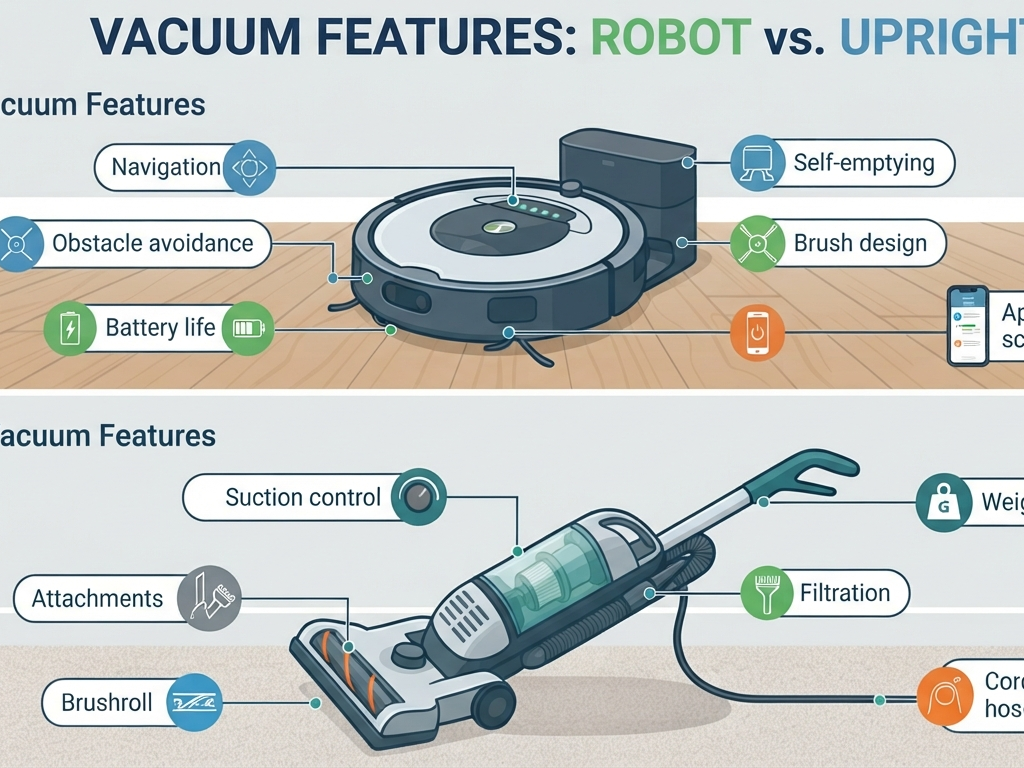
Robot Vacuum Features That Matter
Navigation: When a robot has a good standard map, it can clean more quickly rather than aimlessly.
Obstacle avoidance: This is especially useful if your floors are frequently covered in cables, toys, shoes, or pet bowls.
Battery life: Battery life is critical in larger homes, as the robot needs more time to cover the floor.
Self-emptying: If you do not want to empty the dustbin after every cleaning cycle, it is a useful convenience.
Brush design: This is particularly crucial if you have long hair or pets.
App and scheduling: Instead of a complex app with features you won’t use, look for straightforward room selection, schedules, and cleaning controls.
Upright Vacuum Features That Matter
Brushroll: A good brushroll matters for lifting dirt from carpets and collecting hair.
Suction control: Useful when you move between different floor surfaces.
Attachments: A crevice tool, upholstery tool, and useful stair attachment can make the vacuum much more versatile.
Filtration: Look for an effective filtration system if controlling fine dust is important in your home.
Weight: A powerful vacuum is not very useful if it is difficult to carry upstairs or push around furniture.
Cord and hose reach: Think about how far you can realistically clean without constantly changing outlets or moving the machine.
Should You Buy a Robot Vacuum, an Upright, or Both?
If you still cannot decide, use your biggest cleaning problem as the tiebreaker.
Choose a robot vacuum: If you have a lot of floors, you should get a robot vacuum. This way you will not have to spend a lot of time vacuuming. The robot vacuum can pick up dust and crumbs and hair on its own. It does this on a schedule so you can do things.
Choose an upright vacuum: If you have carpets or stairs or a lot of furniture, you should get an upright vacuum. This is because there are some areas that need extra help. With a vacuum you can decide exactly where you want to clean. You can also use tools to clean things that a robot vacuum cannot clean.
What Should You Avoid When Choosing a Vacuum?
The easiest way to buy the wrong vacuum is to shop by features instead of your home. Before you choose, avoid these common mistakes.
- Avoid chasing big numbers. Better cleaning is not always indicated by a higher number. Airflow, floor type, brush design, and vacuum usage all matter.
- Do not neglect your flooring. If your house has a lot of carpet, a robot might not be the best option for hard floor cleaning on a daily basis.
- The most costly model is rarely the best. If more sensors, applications, and smart features fail to solve a real issue, they are useless.
- Remember the awkward places. Before concluding that a robot can take the position of your upright, consider stairs, furniture, corners, rugs, and confined places.
- Do not overlook maintenance. Every vacuum needs attention. Filters, brushes, dust bins, bags, and robot sensors need regular cleaning or replacement.
- Most importantly, do not expect one vacuum to do everything. A robot is excellent at keeping everyday floor mess under control. An upright is better when you need direct control and deeper cleaning.
Final Thoughts
There isn’t actually a clear winner in the robot vacuum vs. upright vacuum. What your home needs from a vacuum will determine which option is best.
Choose a robot if you want your floors cleaned on a regular basis without having to spend much time doing it. An upright makes more sense if you want to handle the cleaning yourself and have thick carpets, stairs, or furniture.
And there is nothing wrong with having both if you desire deep cleaning and convenience. Keep yourself upright for tasks that require more attention and let the robot take care of the boring daily tasks. Choose the vacuum that best suits your cleaning schedule rather than the one with the most features.
FAQs
Can an upright vacuum be replaced by a robot vacuum?
No, usually. Routine floor cleaning can be done by a robot, but stairs and most surfaces above the floor cannot be cleaned by one. It may also struggle with some deep cleaning jobs.
Is it possible to use an upright and a robot vacuum together?
Indeed. They can work perfectly together. For routine daily cleaning, use the robot, but for deeper or more focused cleaning, use the upright.
Is a robot vacuum better than a standard vacuum?
Not always, but a standard upright vacuum gives you greater control for deep cleaning and challenging places; a robot is excellent for everyday, convenient cleaning.
Are robot vacuums really worth the money?
They can be worth it if you value convenience and want your floors cleaned regularly with less effort. An upright may be more cost-effective if you need regular thorough cleaning or prefer to vacuum by hand.
What is the average lifespan of a robot vacuum and an upright vacuum?
A well-used upright vacuum can last up to ten years, whilst a robot vacuum usually lasts three to five years. Its lifespan is determined by its construction, use, and upkeep.